Tiny house as a modern “výměnek”: housing for parents in your own garden
Aging parents put most families in front of the same question: how do you ensure closeness and help without sacrificing privacy on either side? Traditional solutions – moving parents into the children’s house, or conversely moving to a care facility – have their pitfalls. There is, however, a third way that combines the advantages of both: a tiny house as a “výměnek” (auxiliary dwelling) in your own garden. It’s a standalone, full-fledged, modernly equipped house placed within reach of the main house, where seniors can live independently while still having family close at hand.
This concept builds on the old Czech tradition of the “výměnek” – the part of a farmstead where farmers “retired to” in old age after handing the farm over to the younger generation. Today, a modern mobile home can elegantly take on this role. In this article we’ll look at the practical, legal and financial aspects of this solution and show specific MB Tiny House models from VI invest’s range that are exceptionally well suited to senior living.
The advantages of nearby living: help without losing privacy
The key advantage of a “výměnek” in the garden is the balance between closeness and independence. The senior has their own entrance, their own kitchen, bathroom and living space – i.e. full autonomy and the dignity of independent living. At the same time, children and grandchildren are only a few steps away, which fundamentally changes the quality of everyday care.
What nearby living specifically brings
- Fast help in an emergency – in the event of a fall, sudden illness or medical complication, family is at the door within moments, not tens of minutes by car.
- Preserving the privacy of both households – seniors maintain their own daily rhythm, visits and habits; the younger generation doesn’t lose the intimacy of their own household.
- Intergenerational connection – grandchildren grow up in daily contact with grandparents, an irreplaceable value for both sides.
- The senior’s psychological wellbeing – the feeling of not being alone while also “not being in anyone’s way” significantly reduces stress and the risk of depression in old age.
- Easy care logistics – shopping, cooking, transport to the doctor, and everyday household help are manageable without demanding commutes.
Unlike living together under one roof, where friction often arises from different habits, a separate residential house preserves boundaries. In the long run, this is healthier for family relationships.
Barrier-free access: a house designed for mobility in old age
For a tiny house to truly serve seniors even in the event of reduced mobility, it must be barrier-free. This is an area where MB Tiny House models have a fundamental advantage over improvised solutions – barrier-free design can be planned already at the manufacturing stage, rather than added expensively afterward.
Barrier-free variants of MB Prime and MB Comfort
The MB Prime and MB Comfort models offer barrier-free variants that address the most common risks associated with mobility for older people at home. These specifically include:
- Threshold-free entry – minimizing or completely removing thresholds eliminates the most common cause of tripping.
- Sufficiently wide doors allowing a wheelchair or walker to pass through.
- A spacious bathroom with a floor-level (walk-in) shower, with no need to step over a bathtub rim.
- A single-storey layout – no stairs, no upper floor, everything accessible on one level.
- An access ramp at the entrance instead of steps.
It’s precisely the absence of an upper floor and the compact single-storey footprint that make a tiny house an ideal home for old age – seniors don’t have to tackle stairs every day, which in an ordinary family house represents the biggest barrier.
Legal aspects: the “výměnek” under the Building Act
Many families are put off the idea of a tiny house in the garden by concerns about the building permitting process. The good news is that the new Building Act No. 283/2021 Coll., effective since 2024, has significantly simplified the situation.
What Act 283/2021 Coll. allows
For so-called minor structures up to 80 m² of built-up area serving as an auxiliary structure to a family house, a significantly simplified regime applies. For structures of this type, generally:
- final occupancy approval is not required in full scope as for ordinary residential buildings,
- a simple notification, or a simplified permitting procedure, suffices,
- they fall under the classification of simple structures.
Given that the vast majority of tiny house models are well below the 80 m² threshold, they fall into this advantaged category. That means faster realization and a lower administrative burden.
| Parameter | Requirement / limit |
|---|---|
| Maximum built-up area (simplified regime) | up to 80 m² |
| Final occupancy approval | generally not required |
| Structure type | auxiliary / minor structure to a family house |
| Permitting regime | notification / simplified procedure |
Important note: every municipality and every plot of land has its specifics – zoning plan, setback distances from plot boundaries, protection zones. Before starting, we always recommend a consultation with the local building authority. The VI invest team is happy to help you assess the suitability of your land.
Financing and property-law relationships within the family
Placing a “výměnek” in the garden directly touches family assets, so it’s advisable to also address the legal relationships. Two levels are most commonly addressed here: who finances the house and who ultimately gets it.
Gift agreements and asset transfer
If children are acquiring a tiny house for parents (or conversely parents are contributing to housing on the children’s land), it’s advisable to document the financial flows in writing. In practice these are used:
- A gift agreement – for example when parents give part of the land or funds to children, or vice versa. Gifts between direct relatives (parents–children) are exempt from income tax in the Czech Republic.
- A loan-for-use agreement or an easement (right of habitation) – secures the senior’s right to lifelong use of the house, even if the children own the land. This is key from the standpoint of the senior’s security and can be recorded in the land register.
Inheritance and pre-emption rights
Given that a mobile home is generally a movable item (not permanently attached to the ground) or an auxiliary structure, its inheritance is usually resolved more simply than for real estate. Nevertheless, we recommend:
- clearly specifying in a will or inheritance agreement who will get the house, to prevent disputes between siblings,
- considering a pre-emption right for other heirs if the land is co-owned,
- possibly drawing up a settlement agreement already during the seniors’ lifetime.
Always consult the specific setup with a notary or lawyer – an hour’s consultation investment prevents much costlier disputes.
Real costs: “výměnek” vs. a care home
Economics is often the deciding factor. Let’s compare, for orientation, the costs of a tiny house as a “výměnek” with long-term stay in a care or senior facility.
| Item | Tiny house (“výměnek”) | Care home |
|---|---|---|
| Upfront cost | a one-time approx. CZK 1–2.5 million (depending on model and equipment) | refundable deposit / entry fee CZK 0–hundreds of thousands |
| Monthly costs | only utilities and ordinary operation (approx. CZK 3,000–6,000) | approx. CZK 25,000–45,000 monthly and more |
| Annual costs (operation) | approx. CZK 40,000–70,000 | approx. CZK 300,000–540,000 |
| Residual value | the house remains family property | none |
| Closeness to family | daily contact | limited visits |
The calculation reveals a fundamental difference: while a care home represents a permanent monthly expense that can climb past CZK 1.5 million over 5 years without any residual value, a tiny house is a one-time investment into an asset that remains within the family and retains its value even after years. Over a longer horizon, the initial cost of the house typically pays for itself within 3–5 years compared to paying for a facility.
Moreover, after years the house can be used differently – as an office, a studio, guest accommodation, starter housing for grandchildren, or an object for short-term rental.
Tips for adapting the house to seniors’ needs
For a “výměnek” to truly serve comfortably even at an advanced age, it pays to include a few proven adjustments already when ordering.
Practical interior adjustments
- Grab bars and handles – especially in the bathroom by the shower and toilet, but also along the hallway. Sturdy grab bars significantly reduce the risk of falls.
- Lower thresholds or threshold-free transitions – between rooms and at the entrance, ideally combined with anti-slip flooring.
- A large window and a bright interior – enough daylight matters for seniors both psychologically and for safe movement. Large glazing also visually connects the house with the garden.
- A floor-level (walk-in) shower instead of a bathtub.
- Lever taps and easy-to-operate handles – gentle on a weakened grip due to arthritis.
- Enough free manoeuvring space to turn with a walker or wheelchair.
- Good heating and thermal comfort – seniors are more sensitive to cold, so quality insulation and a reliable heat source pay off.
Suitable MB Tiny House models for seniors
From VI invest’s range, the following models are best suited to senior living:
- MB Comfort – as the name suggests, it emphasizes comfort and spaciousness. Available in a barrier-free variant, suitable for full-fledged everyday living with an emphasis on ergonomics.
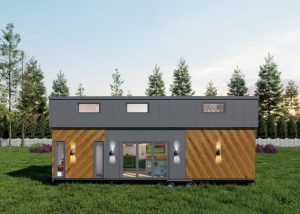
- MB Prime – a premium design with a barrier-free variant, generous glazing, and quality materials. Ideal where the family wants to give parents a truly representative and comfortable home.
Both models can be configured exactly to the needs of a specific senior – from the placement of grab bars through the type of bathroom to the level of insulation. We recommend addressing barrier-free requirements and safety features already when placing the order, when incorporating them is simplest and cheapest.
Conclusion: dignified old age within reach
A tiny house as a “výměnek” in the garden is an elegant connection between tradition and modern living. It offers seniors independence and dignity, the family peace of mind from accessible care, and everyone together a financially sensible solution that, moreover, remains family property. Thanks to the simplified building regime for structures up to 80 m², the barrier-free variants of the MB Prime and MB Comfort models, and the possibility of precise configuration, it’s a path that makes sense practically, legally and humanly.
If you’re considering housing for aging parents, don’t hesitate to contact the VI invest team. We’re happy to help you choose a suitable MB Tiny House model, assess your land, and design a solution tailored to your family.
Frequently Asked Questions (FAQ)
Do I need a building permit for a tiny house in the garden?
For minor auxiliary structures up to 80 m² of built-up area, a simplified regime applies under Building Act No. 283/2021 Coll. – generally a notification suffices and final occupancy approval isn’t required in full scope. However, the specific procedure is always affected by the local zoning plan and setback distances, so we recommend consulting the relevant building authority beforehand.
Is a tiny house cheaper than a care home?
In the long run, significantly so. A care home typically costs CZK 25,000–45,000 monthly with no residual value, whereas a tiny house is a one-time investment (approx. CZK 1–2.5 million) that remains family property. The initial cost usually pays for itself within 3–5 years.
Which MB Tiny House models are barrier-free?
Barrier-free variants are offered by the MB Prime and MB Comfort models. They include a threshold-free entrance, a spacious bathroom with a floor-level shower, sufficiently wide doors, and a single-storey layout with no stairs.
How can I legally ensure a senior has lifelong housing security?
An easement (right of habitation) recorded in the land register is most commonly used, securing the senior’s right to lifelong use of the house regardless of who owns the land. This can be supplemented with a gift agreement and a clear determination of inheritance relationships. We recommend consulting the specific setup with a notary.