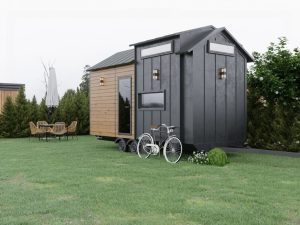
Both options offer mobile living, but in a completely different way. A caravan is a towable vehicle, a tiny house is a house on wheels. The difference sounds like semantics, but in practice it means a completely different approach to living, different legislation, and different costs. We’ll compare both options fairly — no sugarcoating on either side.
Basic comparison
| Criterion | Tiny house (O2/O3 certified) | Caravan / motorhome |
|---|---|---|
| Price | from CZK 1,399,000 excl. VAT | CZK 300,000 – 3,000,000 |
| Area | 17 – 60 m² | 4 – 12 m² |
| Insulation / winter | Year-round, A+ | Depends on the model, usually weaker |
| Kitchen + bathroom | Full-fledged | Miniature, compact |
| Mobility | Tow vehicle, planned relocation | Instant, anywhere |
| Lifespan | 25–40 years | 10–20 years |
| The feel of living there | Like home | Temporary, travel-oriented |
| Glamping yield | CZK 2,000–7,000/night | Low guest interest |
| Czech legislation | Registration plate, insurable as a trailer | Registered vehicle |
What a caravan does better
A caravan has one unbeatable advantage — instant mobility. It’s a ready vehicle prepared to leave at any moment, with no need to plan a relocation with a tow vehicle, no need to disconnect utilities. For someone who wants to be in the mountains today and by the sea in a week, a caravan is the clear choice.
A caravan is also usually cheaper upfront, especially for older or smaller models, and thanks to the widespread network of campsites across Europe, it has infrastructure already sorted out — connection to water, electricity, and waste is standard at most campsites.
What a tiny house does better
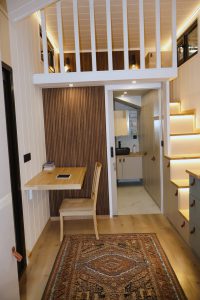
A tiny house, on the other hand, wins where genuine living is concerned, not just traveling. A full-fledged kitchen, a separate bedroom, a spacious bathroom, and year-round insulation make a tiny house comparable to an apartment — just mobile. A caravan is designed for a temporary stay, a tiny house for permanent living.
The difference is also visible in lifespan. A caravan, even a quality one, being built for temporary travel wears out faster — the construction relies on lightweight materials because of weight considerations. A tiny house is built with an emphasis on robustness and a long lifespan, because it’s designed as a permanent dwelling, not a means of transport.
The legal and insurance side
Both types of objects can be operated in the Czech Republic as towed vehicles — with a technical certificate, a registration plate, and mandatory liability insurance. For a caravan, this is a standard, long-established solution. For a tiny house with O2/O3 certification, the same applies, just with the difference that the object simultaneously functions as full-fledged housing.
Insurance is handled similarly for both — mandatory liability and comprehensive insurance like a trailer. The difference is in the insured value: a tiny house, as a more equipped and robust object, tends to be insured for a higher amount, which is reflected in the premium, but also better protects your investment.
Operating costs over time
A caravan has a lower purchase price, but also a shorter lifespan and worse insulation — in practice this means higher heating costs during longer stays outside the season and faster depreciation. A tiny house has a higher upfront investment, but when recalculated per year of use and lower energy consumption, the operation usually works out more favorably, especially if you use the house year-round or rent it out.
When to choose a caravan?
- You want to tour around Europe and change location perhaps every week
- You have a limited budget of up to CZK 500,000
- Weekend or seasonal recreational use is enough for you
- You don’t plan permanent or year-round living
- You’ll appreciate an established network of campsites with ready-made infrastructure
When to choose a tiny house?
- You want permanent or year-round living in nature
- You’re planning glamping or Airbnb rental
- You need full-fledged facilities — a kitchen, a bathroom, a bedroom
- Aesthetics and design matter to you
- You want an investment with good value after ten or more years
- You only plan relocations occasionally, not every week
Transport and logistics in practice
With a caravan, transport is part of everyday operation — the vehicle is built to be quickly hitched up and driven off. A standard category B driving licence usually suffices, or B96 or BE for heavier models.
With a tiny house, transport tends to be a one-time or occasional matter — the house is delivered to the site upon purchase and then stays put until you decide to relocate it. Due to greater weight and dimensions, towing requires a suitable vehicle and often a category BE licence, or C1E for heavier models in the O3 category. Transport over longer distances is therefore usually handled through a specialized transport company, not on your own.
Long-term value of the investment
Both a caravan and a tiny house are legally movable items, so the value of both declines over time — neither will ever become an appreciating “real estate” investment. The difference is in the rate of decline and in what you actually get for that value.
A caravan loses value faster because it’s built for frequent use and a shorter life cycle — after ten years, many models are at the edge of both moral and technical obsolescence. A tiny house, thanks to a more robust construction and longer lifespan, holds its value longer, and it’s also backed by practical utility value as permanent housing or a source of regular rental income, which is absent from a caravan used only occasionally for trips.
A model example: a family looking for a compromise
A family is considering whether to get a caravan for CZK 600,000 for weekend trips, or a tiny house MC4 for CZK 1,399,000 excl. VAT as a year-round recreational property with occasional rental potential. The caravan gives them freedom to travel, but between trips it’ll sit in the yard most of the year. The tiny house, by contrast, stays permanently on the land, serves as a full-fledged facility on weekends and outside the season, and via Airbnb can generate additional income that a caravan without a permanent location can’t produce.
Frequently Asked Questions
Can I travel with a tiny house the same way as with a caravan?
Technically yes — with an appropriate tow vehicle and registration plate it can be relocated. In practice, though, due to greater weight and dimensions, transport requires more careful planning than with a caravan, so it’s better suited to occasional relocations than regular travel.
Is a tiny house more expensive to insure than a caravan?
The premium depends on the insured value of the object. A tiny house, as a better-equipped and more valuable object, will have a higher insured amount, but percentage-wise the mandatory liability and comprehensive insurance rates fall within a similar range as for a caravan.
Does a tiny house last longer than a caravan?
Yes, thanks to a more robust construction designed for permanent living, a tiny house’s lifespan runs between 25 and 40 years, while an ordinary caravan typically lasts 10 to 20 years.
Can you live in a caravan year-round like in a tiny house?
Theoretically yes, but in practice it’s demanding due to weaker insulation and less space. For genuine year-round living, a tiny house is a significantly more comfortable choice.
Conclusion: A caravan is a great travel tool. A tiny house is a home. If you’re looking for genuine living in nature or an investment in glamping, a tiny house wins without question. If you mainly want to travel and change locations, a caravan is the more practical choice. Browse our models or get a free consultation on which type suits you.