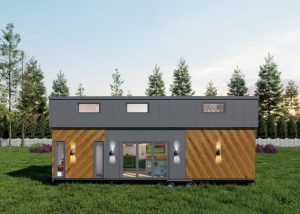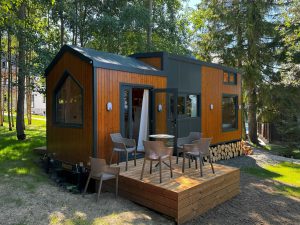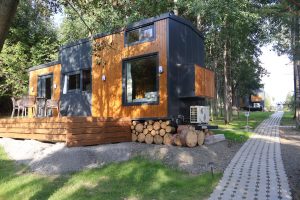
Glamping (from the English glamorous camping) with a tiny house is a form of comfortable accommodation in nature where a certified mobile home on wheels replaces a tent or caravan. In the Czech Republic this segment has grown significantly in recent years, and demand for original, well-equipped accommodation in nature keeps rising.
Glamping vs. camping: the basic difference
Camping means a tent, a sleeping mat, and shared sanitary facilities used by other guests too. Glamping is comfortable accommodation in nature with its own facilities — a private bathroom, a comfortable bed, often a kitchenette as well. Tiny house glamping goes even further: it offers a full kitchen, a bathroom, a separate bedroom, and a terrace, while in the morning you step outside straight into nature, not onto a campsite parking lot.
Why a tiny house is the right choice for glamping
Compared to other types of glamping units — tented igloos, wooden pods, yurts — an MB tiny house has several key advantages:
- O2/O3 certification — legally the unit is a vehicle under EU regulations, so it typically doesn’t need a building permit like a classic structure.
- Mobility — if a location doesn’t work out, you simply relocate the tiny house elsewhere, unlike a permanently built glamping pod.
- Year-round comfort — quality insulation, reliable heating, and a full bathroom allow operation outside the summer season too.
- Attractive design — MB models look noticeably better in photos than standard glamping tents, which directly translates into guest interest on Airbnb and similar platforms.
- Scalability — you start with one unit and gradually add more, without having to go through the extensive building process required for a classic resort.
Where glamping with a tiny house works best in the Czech Republic
Operators’ experience shows that locations with these characteristics perform best:
- Within 1.5 hours’ drive of Prague or Brno — the weekend-escape-from-the-city segment
- Near a body of water, a forest, or with a view of the countryside — Šumava, Lipno, Beskydy, the Máchovo jezero area, southern Moravia
- Private plots away from main roads — quiet and privacy are among the most sought-after qualities for guests looking for glamping
Conversely, locations with dense surrounding development, traffic noise, or no natural view perform noticeably worse for this type of accommodation, regardless of the quality of the unit itself.
How to start a glamping tiny house project
- Land — owned or leased, at least 500 m² per tiny house. Ideally a private plot in a natural setting.
- Choosing a model — the MB7 or MB8 suit two people, the MB9 or MB11 suit families.
- Add-ons — a hot tub, a sauna, an outdoor kitchen, a fire pit. Each add-on raises the achievable nightly rate, but also the upfront investment.
- Airbnb and Booking profile — professional photography, seasonal pricing, instant book availability.
- Launching operations — from signing the contract to the first guest typically takes 6 to 10 weeks, depending on the model’s delivery time and land preparation.
How much a glamping tiny house project costs
Indicative calculation for one MC4 tiny house with a hot tub (prices excl. VAT):
| Item | Price |
|---|---|
| Tiny house MC4 (2026 price list) | CZK 1,399,000 |
| Outdoor hot tub (fixed) | CZK 70,000–120,000 |
| Terrace, foundations, utility connection | CZK 80,000–150,000 |
| Interior fit-out, photography, profile | CZK 40,000–80,000 |
| Total | approx. CZK 1,590,000–1,750,000 |
With annual revenue in the range of hundreds of thousands of crowns (exact figures depend on the model, location, and occupancy), the investment at a well-chosen location typically pays back within a few years — a considerably faster return than a classic long-term rental property investment.
Common mistakes made by first-time operators
- Underestimating the location — even the best tiny house won’t earn money in the wrong place. Invest time in choosing the land before you order a model.
- Missing add-ons — without a hot tub or a sauna it’s hard to compete in a market where competitors already have similar equipment.
- Weak presentation — amateur photos significantly lower occupancy regardless of the unit’s own quality.
- Underestimating the legal side — commercial operation requires a trade licence and, potentially, registration for the local accommodation tax. It pays to sort this out in advance, not after the first bookings.
O2/O3 certification and why it matters
O2 certification (trailers up to 3,500 kg) and O3 (trailers 3,500 to 10,000 kg) is the key reason glamping with a tiny house can launch faster than a classic resort. A unit with this certification is registered as a towed vehicle with a technical certificate and a licence plate, meaning it can legally be moved on EU public roads and operated without a standard building permit, as long as it retains genuine mobility.
For a glamping operator this has a practical impact — from ordering the model to the first guests typically takes weeks, not years, as would be the case for a classic building going through the full permitting process. It also means that if a location doesn’t work out for any reason, the whole unit can be relocated elsewhere without the construction investment going to waste.
Frequently Asked Questions
Do I need a building permit for glamping with a tiny house?
If the tiny house has O2/O3 certification and is operated as a vehicle, you typically don’t need a standard building permit. Specific conditions vary by land and municipality, so we recommend checking in advance.
How many guests fit in one tiny house?
The MB7 and MB8 models are designed for two people, the MB9 for two to three, and the MB11 comfortably fits four.
Do I need a trade licence to operate a glamping business?
Yes, for commercial short-term rental, since it constitutes a business activity. We recommend discussing the situation with an accountant or tax advisor before launching operations.
How long does it take for a glamping investment to pay back?
With a well-chosen location and appropriate occupancy, the payback period for one tiny house with add-ons typically runs to a few years, considerably faster than a classic investment property.
Can glamping with a tiny house operate outside the main season?
Yes, if the unit has quality year-round insulation and reliable heating. Add-ons like a sauna or a hot tub also help maintain guest interest even in colder months, when classic camping essentially doesn’t work.
VI invest is an authorized distributor of MB tiny houses in the Czech Republic. We’ll help you choose a model, design your glamping site layout, and prepare a revenue calculation. Free consultation →