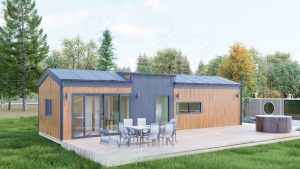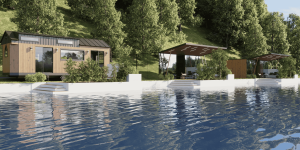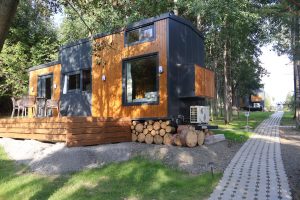
With apartment prices in Prague over CZK 150,000/m², more and more people are asking themselves: what if instead of buying an apartment, I buy a tiny house? The comparison of a tiny house vs. an apartment, however, isn’t just about the purchase price. It decides how much you’ll pay over thirty years, how freely you’ll be able to make decisions, and whether living on a smaller footprint suits you. We’ve calculated it and added what similar articles usually leave out.
Financial comparison: an apartment in Prague vs. a tiny house
Let’s take two specific variants. On one side, a 50 m² apartment in Prague at market price; on the other, an 8 × 2.55 m tiny house with a loft (approx. 30 m²) with land outside a major city. The house price is based on our 2026 price list (MC4 at CZK 1,399,000 excl. VAT, i.e. about CZK 1.7 million incl. VAT); the other figures are rounded market estimates. For the tiny house we assume a CZK 1.7 million consumer loan over 10 years at 7% interest, with the land paid from own funds.
| Item | 50 m² apartment in Prague | Tiny house approx. 30 m² + land |
|---|---|---|
| Purchase price | CZK 7,500,000 | CZK 1,700,000 + 500,000 = CZK 2,200,000 |
| Mortgage / monthly | ~CZK 35,000 / 30 years | ~CZK 19,700 / 10 years (consumer loan) |
| Utilities / monthly | CZK 3,000–5,000 | CZK 500–2,000 (A+, solar panels) |
| Repair fund / management | CZK 3,000–6,000/month | CZK 0 |
| Total costs / month | ~CZK 43,000 | ~CZK 23,000 |
| Overpayment on the mortgage | ~CZK 6,000,000 | ~CZK 670,000 |
| Time to pay off | 30 years | 10 years |
| Cost per m² of floor area | CZK 150,000 | ~CZK 57,000 (excl. land) |
The difference in monthly costs is roughly CZK 20,000. Over ten years – the tiny house’s payoff period – that adds up to over two million crowns that stay with you instead of the bank. That’s the main argument of the whole comparison.
What’s hidden in the apartment’s price
An apartment’s purchase price isn’t the final figure. On top of it come real estate tax, household and building insurance, and above all the repair fund, which in Prague buildings commonly exceeds CZK 3,000 a month. For older buildings, extraordinary contributions for roof, elevator, or facade renovation are also factored in. These amounts aren’t optional, and the owners’ association votes them through regardless of whether they suit you.
Parking also belongs in the budget. In Prague, a parking space is sold separately and costs hundreds of thousands of crowns, or you pay a monthly rent for it.
What’s hidden in the tiny house’s price
The price of the house alone isn’t everything for a tiny house either. Budget for these additional items:
- Land – CZK 500,000 in our model example, but the spread is enormous. Near Prague you’ll pay multiples more than in Vysočina or the border regions.
- Transport and placement – a tiny house is delivered to the site, which requires a passable access road and space for maneuvering.
- Foundations or a hardened surface – depending on the type of placement, either footings or a hardened surface under the wheels.
- Utility connections – electricity, water, and waste. Connections tend to be the most expensive item for more remote plots of land and can easily exceed the price of the land itself.
An alternative is an off-grid solution: photovoltaics with a battery, a water tank, and a composting toilet or a domestic treatment plant. The upfront investment is higher, but it removes the dependence on distance from utilities, and monthly energy payments drop toward the lower end of the stated range.
Where a tiny house wins
Lower upfront investment
The CZK 5.3 million difference in purchase price means that even a household that wouldn’t qualify for a mortgage on a Prague apartment at all can afford a tiny house. Banks assess creditworthiness by the size of the monthly instalment, and the difference between CZK 35,000 and 19,700 a month is decisive for the approval process.
Operating costs
A smaller area means a smaller volume to heat. A modern tiny house is built with an emphasis on insulation and reaches energy class A+. Solar panels are often added on top, covering most of the consumption during the summer months. The result is energy costs in the range of a few hundred to two thousand crowns a month, instead of three to five thousand for an apartment.
A zero repair fund is also a key item. You take care of maintenance yourself and decide when and what gets repaired.
Mobility and the option to change
A certified tiny house on a chassis can be relocated. That’s a property an apartment will never have. When your job, relationships, or liking for the location change, the house travels with you. You then only sell the land, not the entire dwelling.
What a tiny house can’t do (let’s be honest)
- ❌ Can’t be financed with a classic mortgage (without pledging other real estate)
- ❌ Smaller area – requires a different lifestyle
- ❌ Permanent residence is more complicated
- ❌ Value doesn’t grow like real estate
Financing
A mortgage is tied to real estate recorded in the land register. A tiny house on a chassis is, from a legal standpoint, a vehicle, so a classic mortgage doesn’t reach it. What remains is a consumer loan with a higher interest rate and a shorter term, or pledging other real estate. The higher rate, however, is offset by a much lower principal – which is why the table shows a total overpayment of under CZK 700,000, compared to six million for the mortgage.
Permanent residence
Permanent residence is registered at an address with a house or registration number. A tiny house registered as a vehicle has neither. The usual solution is permanent residence at the landowner’s address, or placing the house on land where a structure with a house number already stands. This question needs to be resolved in advance, since it’s tied to mail delivery, your GP, and school for children.
Value over time
Apartments in Prague appreciate over the long term. A tiny house behaves more like a quality movable asset – its value declines, though slowly for certified and well-maintained units. The value of the land it stands on, conversely, grows. If your primary concern is investment appreciation, an apartment is the safer choice in this respect.
The land: an item people forget about
The most common planning mistake is buying the house before the land. Not every plot suits a tiny house. Verify in advance:
- whether the land is accessible for transporting the house, including turning radii and the road’s load capacity,
- how far the electricity, water, and sewerage connections are,
- what the municipality’s zoning plan says about the land’s use,
- whether the land is encumbered by easements or protection zones.
Special rules apply to agricultural land, and placing a house on it is restricted. It pays to consult the municipality before signing the purchase contract.
The legal side: a vehicle, or a structure?
A tiny house can be operated in the Czech Republic in two ways. The first is certification as a towed vehicle, where the house gets a technical certificate and a registration plate. It then doesn’t require a building permit and can be legally relocated. The second way is placement as a structure, which means going through the permitting process under the Building Act, but this opens up the possibility of an assigned house number.
The certified route tends to be simpler and faster. That’s exactly why certification is handled as a standard part of delivery for MB Tiny House models.
Who does a tiny house make sense for as an apartment alternative?
- Singles and couples without children looking for a free lifestyle
- People who want to work remotely and live in nature
- Those who reject a 30-year mortgage and want to be debt-free within 10 years
- An investor looking for passive income from glamping
- A senior looking for housing near family at an affordable price
A model example: a couple in their thirties
A couple with a net income of CZK 70,000 a month. For a Prague apartment they’d need an instalment of CZK 35,000 – half their income – plus their own funds for a down payment. For a tiny house, the instalment is about CZK 19,700 and the upfront investment is significantly lower.
The couple can invest, save, or work part-time with the roughly CZK 20,000 monthly difference in total costs. After ten years they live debt-free, while with the apartment they’d still have two thirds of their repayment schedule ahead of them.
Frequently asked questions
Can you live in a tiny house year-round?
Yes. Certified models are built with year-round insulation and energy class A+. What’s decisive is the quality of insulation, the type of heating, and the ventilation solution, not the size of the house.
Can I get a mortgage for a tiny house?
You can’t get a classic mortgage for a tiny house registered as a vehicle, because it isn’t recorded in the land register. It’s financed with a consumer loan or by pledging other real estate. A mortgage, conversely, can be used to buy the land.
How much does it cost to run a tiny house per month?
In our model comparison, total monthly costs come to roughly CZK 23,000, including the instalment. Utilities alone make up CZK 500 to 2,000, depending on whether the house is grid-connected or uses photovoltaics.
What happens if I want to sell my tiny house?
A certified tiny house is sold as a movable item, via a transfer in the vehicle register. The sale is administratively simpler and faster than for real estate, where you wait for a land register entry. The price, however, will be lower than the purchase price, unlike an apartment.
Conclusion: A tiny house isn’t for everyone – but for the right person, it’s financially significantly more advantageous. If a smaller area doesn’t bother you and you can sort out the land and permanent residence, you’ll save millions of crowns over ten years. Consult with us to find out if that’s your case too.