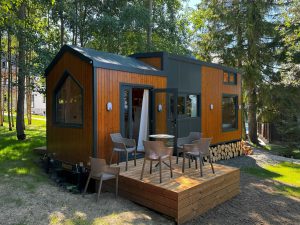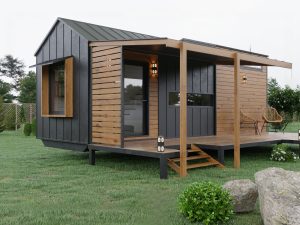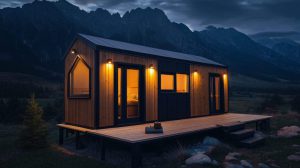
Millions of Czechs own a cottage or cabin — it’s an established tradition and for many families an untouchable value. Yet in recent years, more people are choosing a new tiny house over buying and renovating an old cottage. It’s not just a fashion trend. When the numbers are added up honestly, the comparison turns out differently than you might expect.
Financial comparison: cottage vs. tiny house
Let’s take two real-world options: an older cottage in need of renovation, and a new tiny house with land. Prices are rounded and based on common market values in 2025.
| Item | Cottage / cabin | Tiny house |
|---|---|---|
| Purchase price | CZK 500,000 – 5,000,000 | from CZK 1,399,000 excl. VAT |
| Condition at purchase | Usually needs renovation | New, custom-built |
| Energy class | Typically G–D (unrenovated) | A+ (designed) |
| Heating costs / year | CZK 15,000–35,000 | CZK 3,000–10,000 |
| Maintenance / year | Tens of thousands (older structure) | Low, new build |
| Mobility | None, fixed structure | Relocatable |
| Acquisition speed | Weeks (purchase), months (renovation) | 8–16 weeks (manufacturing) |
The difference in purchase price at first glance favors the cottage — cheaper units go for under a million crowns. But that’s just the first number in the whole story.
The hidden costs of an old cottage
An older cottage at CZK 800,000 can, after the necessary renovation — a new roof, windows, heating, bathroom, electrical wiring — climb to CZK 1,500,000 to 2,000,000. And that doesn’t count the time: renovating an old structure takes months, often over winter, when you couldn’t live there anyway.
After renovation, you’re still left with an energy-inefficient structure. Original masonry without insulation, wooden windows with weaker sealing, an uninsulated floor — all of this can be improved, but rarely to the level of a new building. Annual heating costs for a cottage built in the 1970s or 80s commonly run between CZK 15,000 and 35,000, whereas for an energy-class-A+ tiny house it’s a fraction of that.
The hidden costs of a tiny house
To be fair, a tiny house isn’t just about the price of the house itself either. Budget additionally for land (if you don’t already have it), preparation under the wheels or footings, utility connections or an off-grid solution, and transport to the site. For VI invest models, we state the delivery price in our quote based on the specific location.
Why a tiny house wins overall
Lower upfront risk
With an old cottage, you never know in advance exactly what awaits you under the floor or behind the plaster. A hidden defect in the roof truss, dampness in the masonry, outdated wiring — renovation budgets commonly increase by tens of percent. A new tiny house comes with technical documentation and a warranty, so no such surprise is likely.
Energy independence
A modern tiny house is built with an emphasis on insulation and is often pre-prepared for solar panels. The combination of quality insulation and photovoltaics can cover most of the annual energy consumption, which is practically unachievable for an old cottage without a major renovation.
Airbnb and glamping potential
A tiny house has one major advantage in the short-term rental market — it’s a unique experience that photographs well and sells well. A classic cottage competes with hundreds of similar cottages in the area; a tiny house, especially in designer variants, stands out from the competition and allows for a higher nightly rate.
What a cottage does better
It wouldn’t be fair to claim a tiny house is better in every way. A cottage has its own advantages:
- More area for less money — if you really need a lot of square meters, an older cottage will give you more of them cheaper than a new tiny house of comparable size.
- An established property — a cottage is recorded in the land register, so you can get a classic mortgage for it.
- Emotional value — for many families, a cottage is a generational matter that a tiny house won’t replace.
- Room for your own modifications — extensions, terraces, and adjustments to an old structure have fewer formal restrictions than a certified vehicle.
Land and location
With a cottage, you usually buy the land together with the structure — so the choice of location is dictated by what’s on the market. With a tiny house, you choose the land separately, which gives more freedom but also requires more preparation. Before buying land for a tiny house, verify:
- whether the land is accessible for delivering the house (road width, turning radii),
- how far the electricity, water, and sewerage connections are, or whether you’re planning an off-grid solution,
- what the municipality’s zoning plan says about the land’s use,
- whether it’s agricultural land with restricted use.
Warranty and service: something you won’t get with a cottage
One difference that’s easy to overlook is the warranty. You get none on an older cottage — you buy it as-is, with all the hidden defects you’ll only discover once you’re living there. A new tiny house, by contrast, comes with a warranty period on the structure and roof watertightness, typically several years, and on technical equipment like the air conditioning or solar controller, the warranty terms of the specific equipment manufacturer.
This also affects budget planning. With a cottage, you need to budget a reserve for unexpected repairs practically from year one. With a tiny house, this uncertainty is significantly lower, because all key components have a defined warranty period and a clear service contact.
Who a cottage makes sense for, and who a tiny house does
Choose a cottage if: you already own one in the family, you’re looking for as many square meters as possible for a reasonable price, or you want to finance it with a classic mortgage.
Choose a tiny house if: you want new housing without the risk of hidden defects, you’re planning Airbnb or glamping, you’ll appreciate low operating costs, or you’re not sure about the location and want the option to relocate the house.
A model example: a family considering a recreational property
A family has a budget of CZK 1.7 million. For this amount they can get an older cottage for partial renovation, or a new tiny house MC4 (CZK 1,399,000 excl. VAT) for a plot they already own. The cottage gives them more space immediately, but during the first two years they’ll have to invest further hundreds of thousands into the roof and heating. The tiny house will be finished from the start, energy-efficient, and if needed they can relocate it to a different plot without losing their investment in the structure itself.
Frequently Asked Questions
Is a tiny house cheaper than a cottage?
Not always at first glance — older cottages can be found for under a million crowns. But when you factor in total cost of ownership (purchase + renovation + operation), a tiny house often works out cheaper, because it doesn’t combine the hidden defects of an old structure with high energy consumption.
Can a tiny house be used year-round like a cottage?
Yes, certified models with quality insulation are designed for year-round operation, unlike many older cottages that were built only for seasonal use.
Can I rent out a tiny house the same way as a cottage?
Yes, and in the short-term rental segment a tiny house often performs better thanks to its unique design, which attracts more attention than a standard cottage.
What if I stop liking the tiny house’s location?
With a cottage, you sell the entire property. With a tiny house, you take the house with you and sell only the land — or relocate the house elsewhere and keep using it.
Conclusion: A cottage has its charm and will remain the first choice for many families. But if you’re looking for a modern, energy-efficient alternative without the risk of hidden defects, and with the option to relocate the house in the future, a tiny house offers a comparable or lower total cost at higher comfort. Browse our models or consult with us for a specific calculation for your situation.