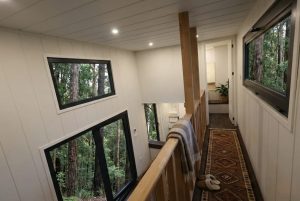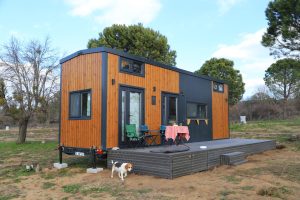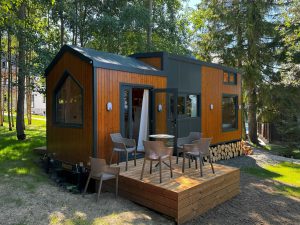
Both types offer an alternative to classic family-house construction. The key difference is fundamental: a tiny house is mobile, a modular house is fixed. That difference runs through the whole decision — from the land, through permits, to financing. Let’s break it down in detail.
Basic comparison
| Criterion | Tiny house (mobile) | Modular house (fixed) |
|---|---|---|
| Mobility | Can be relocated | A fixed structure on foundations |
| Area | 17–60 m² | 40–200+ m² |
| Price | CZK 700,000 – 2,500,000 | CZK 1,500,000 – 5,000,000 |
| Building permit | A vehicle — not needed | Needed, as a structure |
| Type of land | Buildable and non-buildable | Building plots only |
| Mortgage | No, a loan or leasing | Yes, a classic mortgage |
| Permanent residence | Final approval required (or “výměnek”) | Yes, after final approval |
| Delivery speed | 8–16 weeks | 3–12 months |
| Value over time | Slightly declining (a vehicle) | Grows with the real estate market |
The hidden costs of a modular house
The price of a modular house in the table only covers the structure itself. To that, you need to add a foundation slab, utility connections, project documentation, fees associated with the permitting process, and often terrain work on the land. For larger modular houses, these ancillary costs commonly run into hundreds of thousands of crowns extra.
Time is another factor. The permitting process for a structure takes months, for more complex projects even over a year. During that whole time, you’re paying for housing elsewhere, while the investment in your future home sits unused.
The hidden costs of a tiny house
For a tiny house, you need to budget for land, preparation under the wheels or footings, and possibly utility connections or an off-grid solution. For VI invest models, we state the delivery price in our quote based on the specific location. Overall, though, the ancillary costs of a tiny house are significantly lower than for a fixed structure — mainly because you avoid the extensive permitting process.
When to choose a tiny house on wheels
- You want flexibility — the option to relocate the house if your situation changes
- You don’t have a building plot (other land, a garden, etc. suffices)
- You want to avoid a lengthy building permit process
- You’re planning glamping or Airbnb rental
- You need a fast solution — within four months of ordering
- You prefer a lower upfront investment
When to choose a modular house
- You own a building plot and want permanent family living
- You need an area over 60 m² for the whole family
- You want to finance it with a classic mortgage
- You’re planning standard registration of permanent residence without complications
- You expect the property value to appreciate over time
Land and permits in detail
A modular house, as a fixed structure, needs a building plot with a building permit or consent under the Building Act. That means project documentation, statements from affected authorities, and often a geological survey. The process takes months and its outcome isn’t guaranteed in advance.
A tiny house on wheels with O2/O3 certification is assessed as a vehicle, not a structure — as long as it retains genuine mobility (adjustable footings instead of concrete, detachable connections, a functional towing hitch). Thanks to this, it can be placed on land where classic construction wouldn’t be possible, for example in the garden of a family house as a so-called “výměnek,” or on recreational land.
Financing in detail
A modular house, as real estate recorded in the land register, can be financed with a classic mortgage at the lowest interest rates on the market. This is a key advantage for families who want to spread payments over decades at a low monthly burden.
A tiny house on a chassis is legally considered a vehicle, so a classic mortgage doesn’t reach it. It’s financed with a consumer loan or leasing — at a higher interest rate, but also with a significantly lower principal, so the total overpayment often works out reasonably even despite the higher rate.
Build quality: is there really a difference?
There’s a perception that a modular house is automatically of higher quality because it’s a “proper structure.” Reality is more nuanced. A modern tiny house is manufactured in a covered hall under controlled conditions, with precise tolerances and no weather exposure during construction — unlike part of the modular-house process, where final assembly and finishing work happens on site.
The difference is more about scope than build quality. A modular house offers more room for layout options — more rooms, an upper floor, a garage. A tiny house instead focuses on making everything you’d expect from full-fledged living work in a small footprint, and thanks to the smaller volume, a high energy class is easier to achieve.
VI invest offers both
We offer both a mobile tiny house on wheels with O2/O3 certification, and fixed modular models (Tiny house 42, Tiny house 48) for buildable land. Thanks to this, we can advise you based on your specific situation — not just sell you whatever we happen to have in stock.
A model example: land without building designation
A family owns land registered as a garden, not a building plot. For a modular house, they’d first need to change the land’s zoning designation, which takes years and isn’t guaranteed. With a tiny house on wheels, they bypass this obstacle entirely — the object is placed as a vehicle, without needing to change the character of the land, while still getting full-fledged housing with year-round insulation.
Delivery time and why it matters
The difference in delivery speed between the two options is one of the least discussed, yet practically most important factors. For a tiny house on wheels, the standard delivery time runs between eight and sixteen weeks from order, because there’s no need to wait for any permitting process — production runs in parallel with land preparation.
For a modular house, despite faster module assembly, the whole process is extended by the permitting procedure, which can take from a few months to roughly a year, depending on the complexity of the land and the local building authority. For a family that needs housing quickly — for example due to selling their current apartment or an approaching deadline — this difference can be a decisive argument regardless of price.
Frequently Asked Questions
Can I have permanent residence in a modular house?
Yes, after final approval of the structure and registration in the land register, registering permanent residence is a standard process, just as with a classic family house.
Can I have permanent residence in a tiny house on wheels?
Not directly — a tiny house on wheels is legally a vehicle, not a structure with a house number. The solution tends to be a so-called “výměnek” under the Building Act, or permanent residence at the address of another structure on the same land.
Is a modular house faster to build than a classic brick house?
Yes, modular construction is faster than traditional brick building, usually taking months instead of years, but it’s still subject to a standard building permit.
Can a tiny house on wheels later be converted into a fixed structure?
For some models this is theoretically possible, but it means losing the vehicle status and needing to go through a standard building permit. If you know from the start that you want a fixed structure, it’s simpler to choose a modular model directly.
Conclusion: The choice between a tiny house on wheels and a modular house ultimately comes down to one question — do you have a building plot and want to live there for good, or are you looking for flexibility and a fast solution without lengthy permitting? Browse our full range or get a consultation about which option suits your land and plans.