A wagon caravan, or a tiny house? A comparison that will save you hundreds of thousands
Are you looking for mobile housing you can place on your own land without a complicated building process? Then you’ve probably come across two options that at first glance seem similar: a wagon caravan (“maringotka”) and a tiny house. Both sit on a chassis, both offer small-scale living, and both can be relocated. But the differences between them are fundamental – from insulation and year-round habitability, through lifespan, to price, which can differ by as much as a million crowns.
In this article we’ll explain in detail how a wagon caravan and a tiny house actually differ, when the cheaper wagon caravan pays off, and when, conversely, an investment in a quality tiny house from VI invest pays for itself many times over. At the end you’ll find a clear comparison table and answers to the most frequent questions.
What is a wagon caravan and what is a tiny house?
The wagon caravan – history and the present
A wagon caravan (sometimes called a “marinka” in Czech, in English a wagon or caravan) is a traditional mobile shelter on a chassis, originally used by construction workers, seasonal labourers or foresters as temporary accommodation. A classic wagon caravan has a simple metal or wooden structure, usually a single room of 8 to 18 m², and minimal equipment. In recent years it has experienced a renaissance as cheap recreational housing, a garden house, or guest accommodation.
Modern “designer” wagon caravans try to approach tiny house comfort, but they’re still based on a lighter and simpler construction. The wagon caravan’s main asset remains its low purchase price and easy availability – you can even get one secondhand for tens of thousands of crowns.
The tiny house – a small house for full-fledged living
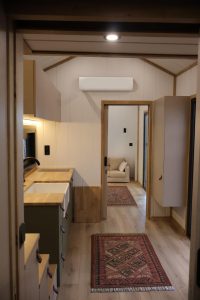
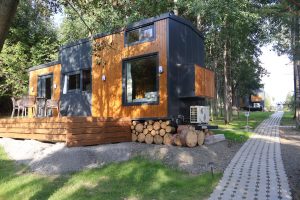
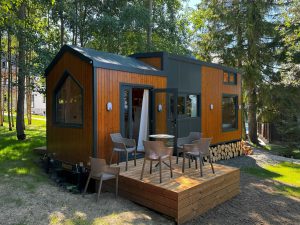
A tiny house, by contrast, is a full-fledged small house built on a type-approved trailer chassis. The tiny house philosophy originated in the USA as a response to overpriced real estate and a desire for a simpler, minimalist life. A tiny house typically has an area of 15 to 35 m², multi-layer insulation, quality double- or triple-glazed windows, its own bathroom, kitchen, and often a sleeping loft as well.
The fundamental difference lies in the approach to construction: while a wagon caravan is a “shed on wheels”, a tiny house is designed as permanent housing meeting the parameters of year-round living. VI invest models are built on a certified chassis with documentation, thanks to which they can be legally registered as a towed vehicle while also offering comfort comparable to an ordinary apartment.
Insulation and year-round use: where the biggest difference lies
If a single criterion should decide, it’s precisely insulation. And on this point, the tiny house clearly wins.
A classic wagon caravan has thin walls, often with minimal or no thermal insulation. In summer it heats up like an oven, in winter heat escapes faster than you can replace it. A wagon caravan is therefore suitable mainly for seasonal use from spring to autumn. Living in it through the winter is theoretically possible, but it means high heating costs and a risk of condensation, dampness and mould.
A tiny house from VI invest, by contrast, has multi-layer insulation in the walls, floor and ceiling, a vapour barrier, and quality windows. Thanks to this, it maintains a pleasant temperature both in winter and summer and is fully adapted for year-round living. The small volume of space also heats up quickly, so a well-insulated 25 m² tiny house consumes only 1,500 to 3,000 kWh a year for heating. That’s significantly less than an ordinary house, and less than an uninsulated wagon caravan.
The conclusion is clear: if you want to live there year-round, a tiny house is practically the only sensible choice. A wagon caravan is suitable as a summer retreat or an add-on, not as the main dwelling for the freezing months.
The legal situation: a vehicle, or a structure?
One of the most common questions is whether a wagon caravan or a tiny house needs a building permit. The answer is similar for both and depends on the specific design.
The towed-vehicle route (registration plate)
Both a wagon caravan and a tiny house can be placed on a type-approved chassis with a registration plate and thus function as a towed vehicle. Under this regime:
- you don’t need a building permit,
- you can legally park the object on land where this is permitted,
- however, you cannot establish permanent residence there or have a house number assigned,
- the object must remain genuinely mobile – i.e. without a permanent foundation.
Beware of a key trap: as soon as you connect fixed utilities (electricity, water, sewerage) or build a brick terrace and foundations, the authority may reclassify the object as a structure, with all the consequences that entails.
The “product fulfilling the function of a structure” route
The second option is assessment as a “product fulfilling the function of a structure” (VPFS). Under Building Act No. 283/2021 Coll., such an object requires a permit for the intended project, but it can be recorded in the land register, permanent residence can be established there, and it can (with difficulty, but possibly) be financed with a mortgage.
From a legal standpoint, both a wagon caravan and a tiny house are in a similar situation. The difference is that a quality tiny house from VI invest comes with technical documentation and chassis certification (category O2/O3), which significantly eases registration as a vehicle as well as any dealings with authorities. For a cheap wagon caravan without documents, legalization can be more complicated.
Price: where the wagon caravan wins, and why that might not be a victory
Price is the most common reason people consider a wagon caravan at all. The differences are indeed large:
- Wagon caravan: approximately CZK 150,000 to 400,000 new, even less for older secondhand pieces.
- Tiny house: CZK 1,399,000 to 1,599,000 excl. VAT for year-round VI invest models (2026 price list).
At first glance, a wagon caravan is cheaper by hundreds of thousands of crowns. But you need to look at the cost over the entire period of use, not just the purchase amount. A cheap wagon caravan has a shorter lifespan, worse insulation (and therefore higher energy costs), and a lower residual value on resale. When you recalculate the costs per year of living, the difference shrinks considerably – and for year-round use, a wagon caravan can even come out more expensive because of heating and repairs.
A tiny house is therefore a higher upfront investment, but an investment in durable, comfortable housing that holds its value.
Lifespan: 20 years versus half a century
Lifespan is another point where the two solutions fundamentally diverge. An ordinary wagon caravan lasts roughly 15 to 20 years before the structure, cladding and floor require major repairs or replacement. Lighter materials, thin walls, and lower resistance to moisture mean that after two decades, a wagon caravan is usually nearing the end of its life.
A well-built tiny house from VI invest, thanks to its robust construction, multi-layer insulation, and quality cladding, has a lifespan of 30 to 50 years – comparable to a light timber-frame building. With ordinary maintenance (caring for wood surfaces, checking the roof and windows), it will serve you for generations.
When you recalculate the purchase price per year of lifespan, the difference between a wagon caravan and a tiny house narrows further. A tiny house is more expensive, but it serves more than twice as long.
Land availability and placement
In terms of placement, both a wagon caravan and a tiny house have an advantage over a classic structure – both can, under the towed-vehicle regime, be placed on land where a brick house wouldn’t be approved.
Before placement, it’s necessary in both cases to check the municipality’s zoning plan. Look for a functional use of type BI (individual housing), BV (rural housing), or RI (individual recreation). We recommend requesting zoning information from the building authority to be sure. Watch out for agricultural land fund (ZPF) status – on arable land or a garden classified as ZPF, an object cannot be permanently placed without consent to its removal from agricultural use.
A practical advantage of the wagon caravan is its lower weight and smaller dimensions, thanks to which it can more easily reach less accessible plots of land and is easier to transport. A tiny house is heavier and larger, so transport requires more careful planning, often including an escort vehicle. For permanent placement, however, this isn’t an obstacle – it’s a one-time matter during delivery.
Insurance
The method of insuring both objects depends on their legal status, so the principles are the same:
- As a towed vehicle (registration plate): you take out mandatory liability insurance and comprehensive insurance, similar to a caravan or a trailer. Products are offered by insurers such as Allianz, Kooperativa, or Generali Česká pojišťovna.
- As a structure: you take out building insurance (natural disasters, fire, water, vandalism) and household contents insurance.
The approximate insurance price runs around CZK 3,000 to 8,000 a year. Here too, quality documentation helps: a tiny house from VI invest with a technical certificate and O2/O3 certification is easily insured without disputes over “what this actually is.” For an older wagon caravan without papers, arranging insurance can be more complicated and more expensive.
Comfort and equipment
This is where the difference in philosophy between the two solutions fully shows. A wagon caravan offers basic equipment – usually one living space, a small kitchenette, sometimes a chemical toilet and a shower. For a summer stay in the garden or occasional overnight stays, this is more than enough.
A tiny house, by contrast, is designed as a full-fledged home. As standard, it offers:
- a separate bathroom with a shower and toilet,
- a fully equipped kitchen with a fridge, hob, and storage space,
- a living area with a dining section,
- a sleeping loft or a separate bedroom,
- quality heating (a wood stove, infrared panels, or a heat pump),
- large windows for plenty of daylight and a connection with the surroundings.
So if you’re looking for housing where you’ll spend most of your time and which should offer real comfort, a tiny house is a level above.
Comparison table: wagon caravan vs. tiny house
| Criterion | Wagon caravan | Tiny house (VI invest) |
|---|---|---|
| Area | 8–18 m² | 15–35 m² |
| Price | CZK 150,000–400,000 | CZK 1,399,000–1,599,000 excl. VAT |
| Insulation | minimal to none | multi-layer, year-round |
| Year-round living | unsuitable / demanding | fully adapted |
| Lifespan | approx. 20 years | 30–50 years |
| Legal status | vehicle or structure | vehicle (O2/O3) or structure |
| Comfort and equipment | basic | full-fledged home |
| Documentation / certification | often missing | certified chassis, technical certificate |
| Insurance | possible, sometimes more complicated | easy thanks to documentation |
| Mobility / transport | very easy (light) | more demanding (heavier, larger) |
| Suitable for | seasonal, temporary, cheap | long-term, year-round |
Conclusion: when a wagon caravan, and when a tiny house?
The choice between a wagon caravan and a tiny house ultimately comes down to one question: how long and how intensively do you want to use the object?
Choose a wagon caravan if:
- you’re looking for the cheapest possible solution on a minimal budget,
- you plan only seasonal, summer, or occasional use,
- you need temporary facilities for the garden, a construction site, or guests,
- you don’t mind lower comfort and a shorter lifespan.
Choose a tiny house if:
- you want to live there year-round and in full comfort,
- quality insulation and low energy costs matter to you,
- you’re looking for a permanent solution with a lifespan of decades,
- you’ll appreciate a certified chassis, easy insurance, and higher residual value.
If you’re drawn to the low price of a wagon caravan but want to live comfortably and year-round, a tiny house from VI invest is the ideal alternative. It combines mobility and a relatively favourable purchase price with the comfort of a full-fledged home, multi-layer insulation for year-round living, and a certified chassis that eases both registration and insurance. While a wagon caravan is a solution for a few seasons, a tiny house is a home for decades – and calculated per year of use, it need not even be significantly more expensive. Take a look at our models and we’ll advise you on which one best suits your land and your way of life.
Frequently Asked Questions
Is a wagon caravan cheaper than a tiny house?
Yes, the purchase price of a wagon caravan (CZK 150,000–400,000) is significantly lower than that of a tiny house (CZK 1,399,000–1,599,000 excl. VAT). But when recalculated to total costs over the entire period of use, the difference narrows – a tiny house lasts more than twice as long, has better insulation and therefore lower heating costs, and a higher residual value.
Can you live in a wagon caravan year-round?
Theoretically yes, but in practice it’s demanding and uncomfortable. A classic wagon caravan has minimal insulation, so heat escapes in winter and there’s a risk of condensation and mould. For year-round living, a tiny house with multi-layer insulation is more suitable, maintaining a pleasant temperature all year at low energy costs.
Do I need a building permit for a wagon caravan or a tiny house?
The same rule applies to both. Under the towed-vehicle regime on a type-approved chassis (registration plate), you don’t need a building permit, but you must not permanently connect the object to utilities or build it on a permanent foundation. If you want permanent residence and a land register record, it’s a product fulfilling the function of a structure, which requires a permit for the intended project under the Building Act.
How long does a tiny house last compared to a wagon caravan?
A wagon caravan has a lifespan of approximately 20 years, a quality tiny house from VI invest 30 to 50 years. The longer lifespan comes from a more robust construction, better insulation, and higher-quality cladding. With ordinary maintenance, a tiny house thus serves like a full-fledged timber-frame building for several decades.