How much does a tiny house cost in the Czech Republic in 2026? VI invest’s complete pricing guide
A tiny house is no longer an exotic curiosity from foreign documentaries – in 2026 it’s a real, affordable alternative for housing and for investing in recreational property. Yet the question “how much does a tiny house actually cost?” is among the most common ones we answer at VI invest. The price isn’t made up solely of the figure on the price list. It’s shaped by the model’s construction and equipment, certification, transport, land preparation, and the method of financing. In this article, we’ll break down the pricing of our mobile tiny houses down to the last detail, show a real example of total costs, and explain why cheap direct imports from abroad often end up more expensive.
Tiny house price list 2026
Our range covers compact houses for two as well as more spacious layouts with a separate bedroom. The prices below apply to the standard specification according to the price list valid from 1 January 2026 and are stated excluding VAT.
| Model | Description | Price excl. VAT |
|---|---|---|
| MC4 | Compact house, kitchen, bathroom, sleeping loft | CZK 1,399,000 |
| MC1 Loft | Up to 8 m, living room with kitchen + bedroom, up to 4 people | CZK 1,449,000 |
| MB 2 | 7.00 × 2.55 m + loft, 2–4 people | from CZK 1,467,200 |
| MAR 3 | 8.00 × 2.55 m + loft, separate bedroom, 2–4 people | CZK 1,469,755 |
| MC2 Loft | Kitchen, bathroom, spacious sleeping loft | CZK 1,489,000 |
| MC1 | Tiny house with loft, living room with kitchen, 4 people | CZK 1,499,000 |
| MA1 | Full kitchen and bathroom, sleeping loft | CZK 1,499,990 |
| MC2 | For year-round living, holidays and investment | CZK 1,499,990 |
| MA2 / MAR 2 | 8.00 × 2.55 m + loft, 2–4 people | CZK 1,517,747 |
| MC 2+1 | Bedroom, living room, kitchen and bathroom downstairs + loft | CZK 1,599,000 |
You can download the full price list (PDF) with photos, floor plans and optional equipment. The difference between the most affordable and the most spacious model is CZK 200,000. It mainly reflects the layout, the number of rooms and the scope of equipment. We therefore recommend not deciding purely on price, but on actual purpose – a tiny house for occasional weekends has different requirements than a structure you want to live in permanently, even in winter.
What’s included in the base price
The base price isn’t a “bare shell”. It includes a finished, habitable structure ready for use once connected to utilities. Specifically, the price includes:
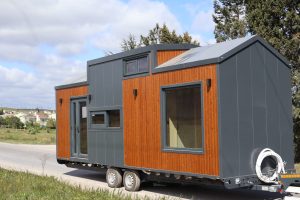
- Trailer chassis with a 3,500 kg load capacity, 4 jacks, a front support wheel, braked axles and coupling – the house is a towed vehicle that gets registered and receives a licence plate.
- An insulated structure of galvanised steel profiles – walls 10 cm, floor 15 cm, roof 10 cm (mineral wool, XPS, vapour barrier).
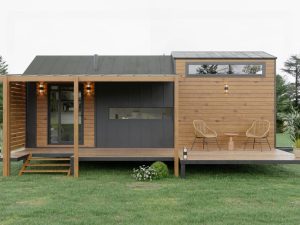
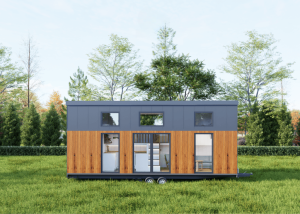
- Exterior of composite, Finnish thermowood and aluminium; insulated windows and doors with insect screens.
- Interior equipment – a kitchen unit with sink and hob, a bathroom with shower, washbasin and WC, furniture and a loft staircase with storage.
- Installations – electrical wiring with circuit breakers, sockets and switches, clean and waste water lines, electric underfloor heating and air-conditioning preparation.
- Lighting – LED and spot lighting inside and outside.
In other words – the base price covers everything that makes a tiny house a tiny house. What adds to it are optional upgrades and costs tied to a specific piece of land.
What adds to the price: above-standard equipment
The second layer of the price is optional equipment. This is where comfort, energy self-sufficiency and the overall character of the house are decided. Selected items from the 2026 price list (prices excl. VAT):
| Element | Benefit | Price excl. VAT |
|---|---|---|
| Solar power – panels, battery, infrastructure | Energy self-sufficiency, off-grid operation | CZK 95,400 |
| Off-grid tanks 290 l + 290 l, heating, pump | Operation without water and sewer connections | CZK 73,350 |
| Air-conditioning unit incl. installation | Cooling and supplementary heating | CZK 58,000 |
| Thermowood terrace + steps (approx. 2.4 × 6 m) | Extends the living space | from CZK 126,500 |
| Kitchen appliances (oven, microwave, hob, fridge) | Fully equipped kitchen | CZK 5,800 – 9,600 each |
| Designer wall cladding | Higher interior aesthetics | from CZK 30,400 |
Combining solar power with off-grid tanks is popular especially on remote plots – the house then needs no utility connections, and the higher upfront cost pays back in low running costs. All optional items are listed in the downloadable price list.
Additional costs: transport, foundation and utility connections
Many prospective buyers underestimate the third layer of cost, yet it can affect the budget by tens to hundreds of thousands of crowns. These are the costs tied to placing the structure on a specific plot of land.
Transport
We state the cost of transporting the tiny house to its destination in our quote – it depends on the distance and access to the plot. Complicated terrain may require an escort vehicle or crane, which increases the price.
Foundation and substrate
A tiny house needs a stable, load-bearing, level base. Depending on the type of land, ground screws, concrete footings, or a foundation slab may be used. Costs typically run CZK 30,000 – 120,000. The price is affected by the substrate’s bearing capacity, the slope, and the chosen solution – ground screws tend to be faster and cheaper than a concrete slab.
Utility connections
Connecting to electricity, water, and sewerage is the least predictable item, because it depends on the distance from existing utilities. For land with connections “at the boundary”, it might be tens of thousands of crowns; for more remote locations, it can be CZK 100,000 or more. An alternative is an off-grid solution (solar panels, a cesspit, your own water source), which reduces dependence on utilities but shifts some of the cost back into the structure’s equipment.
Direct import from abroad: an apparent saving, a real risk
Online, you’ll come across offers for tiny houses from abroad at temptingly low prices. Before deciding to save by importing directly, consider the risks that the price doesn’t show at first glance:
- Missing O2/O3 certification – without it, you can’t legally register the structure as a trailer in the Czech Republic or transport it on public roads. Retroactive type approval is lengthy, costly and not always feasible.
- Unknown insulation and construction quality – structures from warmer climate zones often don’t meet the requirements for Czech winter operation.
- Complicated warranty claims and service – dealing with a defect with a foreign supplier remotely is problematic and often impractical in reality.
- Hidden import costs – international transport, potential customs duties, and modifications to meet Czech standards can completely erase the apparent saving.
At VI invest, you get a structure certified for operation in the Czech Republic, with Czech service and clearly defined parameters. In the long run, this is both a safer and cheaper option.
VAT 12% vs. 21%: classification matters
The VAT rate for a tiny house depends on how the structure is classified. If it meets the conditions for a housing structure / social housing (particularly in terms of floor area and use as permanent housing), the reduced rate of 12% applies. If the structure is classified as a movable item – a trailer for recreational or other non-permanent housing use – the standard rate of 21% applies.
The difference isn’t small: for a model priced at CZK 1,499,990 excl. VAT, it amounts to roughly CZK 135,000. The specific classification always depends on the purpose of use and current legislation, so we recommend assessing it individually. Our team will help you determine the correct rate for your specific intent.
Financing a tiny house: mortgage, loan, or leasing?
The method of financing affects not only the monthly payment but also the total price you’ll pay for the structure. The three most common routes:
A mortgage loan
The lowest interest rate of all options, but a classic mortgage requires the structure to be permanently connected to the ground and registered in the land register as real estate. A mobile tiny house on a chassis generally doesn’t meet this condition. But if you place the structure on a foundation slab as a housing structure, a mortgage can become a real and most advantageous option.
A consumer loan
The most flexible option – it doesn’t require registering real estate, and processing is fast. The interest rate is higher than for a mortgage, but for a mobile tiny house it’s often the most practical solution. Suitable for financing both the structure and above-standard equipment in one.
Leasing
Because a tiny house with O2/O3 certification is registered as a trailer, leasing is also possible – similar to vehicles. This is especially attractive for entrepreneurs and companies (an office, accommodation, a business premises), who can claim the payments as expenses. You become the owner once fully paid off.
A real example: total costs for an MC2
To keep the numbers from staying purely theoretical, let’s calculate a model budget for year-round living in an MC2 with solar power, air conditioning and a terrace, placed on ordinary land with utilities within reach. Foundation and connections are rough estimates; all other items come from the 2026 price list.
| Item | Price excl. VAT |
|---|---|
| Base price of the MC2 (standard specification) | CZK 1,499,990 |
| Solar power – panels, battery, infrastructure | CZK 95,400 |
| Air-conditioning unit incl. installation | CZK 58,000 |
| Thermowood terrace + steps | CZK 126,500 |
| Foundation (ground screws) – estimate | CZK 55,000 |
| Utility connections – estimate | CZK 70,000 |
| Total excl. VAT (excl. transport) | CZK 1,904,890 |
From a list price of CZK 1,499,990, the total cost excluding VAT and transport climbed to roughly CZK 1,905,000 – about 27% more. The key takeaway: for a tiny house, budget a reserve of roughly 20–35% on top of the base price for optional equipment and installation, plus VAT and transport according to the quote. The final amount, however, varies considerably depending on the land and chosen equipment – the same model without solar panels and with connections at the boundary of the plot comes out significantly cheaper.
Conclusion: the price of a tiny house is about the whole picture, not the price list
A mobile tiny house from VI invest costs from CZK 1,399,000 excl. VAT (MC4) to CZK 1,599,000 excl. VAT (MC 2+1) in 2026. A real investment, however, always includes optional equipment, transport, foundation, utility connections and VAT. It’s precisely this transparent breakdown of costs, registration of the house as a towed vehicle, and Czech service that set a purchase from an authorized VI invest dealer apart from a risky import from abroad. We therefore recommend starting by defining your purpose and your land – only then does the price make sense. We’re happy to put together a no-obligation calculation tailored to your model and location.
FAQ – frequently asked questions about tiny house prices
- How much does the cheapest tiny house from VI invest cost?
- The most affordable model is the MC4 at CZK 1,399,000 excl. VAT in the standard specification. On top of this price, you need to add VAT, transport, foundation, and any utility connections depending on the specific plot of land.
- What reserve should I budget beyond the list price?
- For year-round living, we recommend budgeting a reserve of roughly 20–35% of the base price for optional equipment, foundation and utility connections, plus VAT and transport according to the quote. For simpler use without solar power and a terrace, the reserve will be lower.
- What VAT rate applies to a tiny house?
- It depends on classification. If the conditions for a housing structure are met, the reduced rate of 12% applies; for a structure classified as a trailer for recreational purposes, the rate is 21%. We’ll assess the specific classification individually based on the intended use.
- Can a tiny house be financed with a mortgage?
- Yes, if the structure is placed on a foundation slab and registered as real estate. A mobile tiny house on a chassis is usually financed with a consumer loan or leasing – leasing is used mainly by companies, thanks to the ability to claim payments as expenses.